

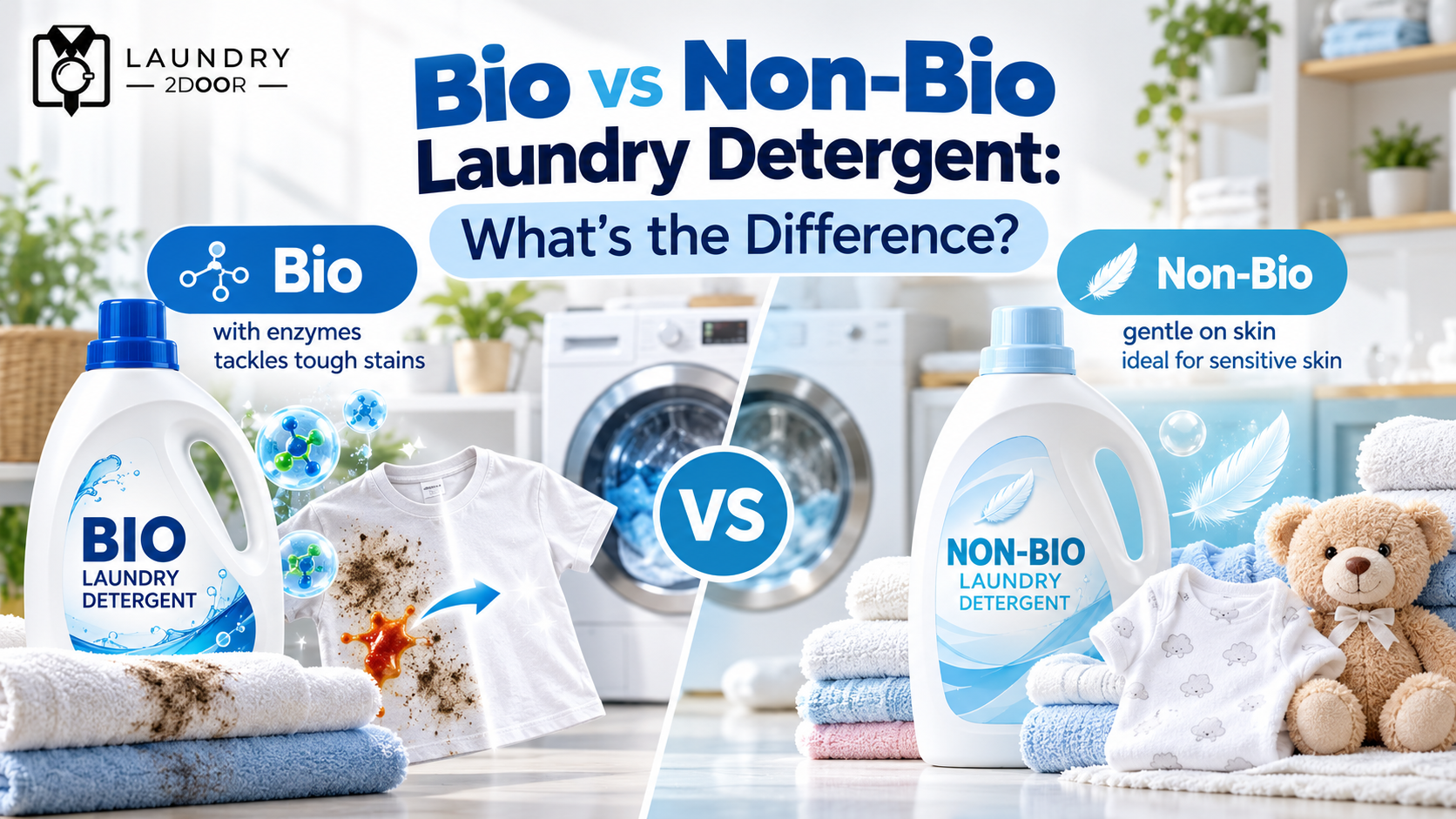
If you pop into the laundry section of a UK supermarket, you’ll be presented with two well-known choices: biological and non-biological washing powder. You could find it easy to tell them apart but choosing amongst them can surely be a tough job.
When do I use bio washing powder? What about Sensitive Skin Non Bio? And it is best to utilize bio at lower temperature like 30 C?
The fundamental difference between bio and non-bio laundry detergent is the enzymes. Bio detergent contains enzymes that break down stains , non bio does not .
But of course, enzymes aren’t the only things to think about. Think about the type of fabric, the wash temperature, the formula of the detergent and your preferences.
If you’re struggling to decide which detergent to buy, this article is for you. This article also discusses the scientific basis for both forms of detergent.
Bio vs Non-Bio Laundry Detergent: What’s the Difference?
In the UK, ‘bio’ is short for ‘biological’ and means that there are enzymes in the detergent.
Detergent enzymes are designed to deal with different types of stains.
“Non-bio” signifies the detergent does not have such types of enzymes in it.
“Non-bio” does not indicate the detergent is 100% natural, free from synthetic ingredients or automatically suitable for delicate skin.
Both bio and non-bio detergents contain cleansing chemicals and should be used carefully as instructed on the label.
What Is a Biological Laundry Detergent?
Biological laundry detergents contain different chemicals to eliminate dirt, stains and odors.
These comprise surfactants, cleansers, builders, enzymes and other chemicals.
Food and body stains are widespread in everyday use, thus biological detergents are highly useful.
Powders, liquids, gels and capsules are among the numerous types of bio detergents available.
It’s not only the bio label, the full formula of a product is also vital to its performance.
How Do Enzymes in Biological Detergent Work?
Enzymes are proteins that help break down bigger molecules into smaller pieces that can be readily washed away.
Enzymes work on a wide variety of various stains.
Enzymes are found in many varieties.
For example, blood, egg, and some dietary remnants are broken down by Protease.
Lipase breaks down food stains including oils and fats.
Amylase breaks down carbohydrate-based stains like food starches.
Cellulase helps with fabric maintenance and also breaks down certain residues in cotton.
Important to keep in mind that not all biological detergents include all of the enzymes listed above.
What Kind of Stains Does Bio Detergent Remove?
Biological detergents are good for removing food, perspiration and oily stains.
A wash with a biological detergent can help to remove food stains on a school shirt or clothes that have absorbed body oils.
However, enzymes will not help erase all stains.
Other stains, including coffee and tea, may require other substances or a different procedure.
Always check the care label for the fabric type and guidelines for the stain before using a bio detergent.
Advantages and Disadvantages of Bio Washing Powder?
There are a number of advantages to bio detergent.
The enzymes help to break up and eliminate the stains.
This means that bio detergents can clean garments at a lower temperature.
This can make it useful for a daily wash.
Not all fabrics can stand enzymes though and some sensitive protein fibers like silk and wool can only stand a detergent formulated specially for them.
Plus, a person’s skin may react to the ingredients in the bio detergent.
What is Non-Biological Laundry Detergent?
A non-biological laundry detergent cleans clothes without using enzymes.
Non-bio detergents are popular in the UK, particularly with people who prefer non-enzyme detergents or have specific demands for their washing.
Non-bio detergents come in powder and liquid versions.
How Does Non Bio Detergent Clean Clothes Without Enzymes?
Non bio detergent comprises surfactants and other chemicals that clean and remove stains.
Surfactants aid to emulsify stains and enable water to wet clothes.
Some non-bio powders may contain oxygen bleach ants. Other persons may employ other ways of cleaning.
Overall the performance is rather inconsistent.
Non-bio detergent may be used to clean standard clothing that is not excessively discolored.
Non-Bio Washing Powder: Advantages and Disadvantages
Non-bio detergents usually do not contain enzymes and this is a benefit.
So if you want to stay away from enzymes, these items can be a better choice.
Non-bio detergents also tend to be less fragrant and may be more bearable for sensitive skin.
Does Non-Bio Detergent Get Stains Out?
Yes, typical stains can be removed with non-bio detergents.
Using non-bio detergents to remove stains will be more effective if the correct wash program is adopted and the affected region is pre-treated.
Non-bio detergents might leave residue if too much is applied. Using more detergent won’t help remove tough stains.
Biological vs. Non-Bio Detergent
When selecting a detergent, the most important thing is its capacity to remove stains. Enzymes in biologicals are made to break down stains and often have the advantage in terms of stain removal.
But there are caveats to this.
A well designed non-bio detergent can be better than a poorly designed bio detergent at stain removal.
Other elements such as the temperature and length of the wash and any pretreatment can also influence the outcome.
Removes stains of food, grease and protein
Blood stains can be tough to get out. Some sources recommend using a stain solution before washing. Always follow the manufacturer’s directions.
Pre-treatment is always advisable.
For especially tough stains, choose the warmest water temperature advised on the garment’s care label.
Biological vs Non-Bio For Sweat & Daily Laundry
Bio detergents are made to deal with common dirt like body oils and sweat and can work well for clothes worn often.
If worn every day, non-bio detergent can also be used to remove sweat and body filth.
It is not always the detergent that is to blame if garments smell bad after washing.
Check our tutorial on why does laundry smell awful after washing them.
Does Bio Detergent Clean Better at Low Temperatures?
Enzyme action in detergents facilitates stain removal at lower temperatures. Some enzymes are adapted to work at 30°C and hence are suitable candidates for helping remove stains in a 30°C wash.
This is one of the key reasons why biological detergents are recognized to help with stain removal at lower temperatures.
However, a number of things will affect how well a stain is removed, including the type of stain, the type of detergent used, and the wash cycle.
Heavy soiling may necessitate a lengthier wash cycle or a higher wash temperature than indicated by the care label.
Bio or non-bio detergent – which is better for sensitive skin?
One technique to help lessen the chance of skin irritation when doing the laundry is to use a non-bio detergent, this is a common choice for those with sensitive skin.
That said, biological enzymes are not proven to induce eczema flare ups and general sensitivity.
The smell and the residue may be the worse problem.
Biological Detergents Biologics can irritate skin.
Always take individual sensitivity into account when using a new detergent.
But that’s not always the case, just because one person may be sensitive to a certain detergent. There could be additional substances that are of larger concern, such as fragrance.
If you notice irritation on your skin after using a new detergent, take a look at the contents list and make sure it’s not highly fragranced. Also make sure that the correct amount is being used and that clothing are rinsed properly.
If irritation persists or is severe, consult a health care provider.
Could Non-Bio Washing Powder Help Eczema?
People with eczema are often advised to use a non-bio washing powder, but there is not enough data to say this is always the superior choice.
Eczema Care Online says: “There is no real proof that non-bio detergents are healthier for people with eczema.
For some folks a no scent or low fragrance detergent might be appropriate and for others wearing ordinary clothes might be fine.
Ultimately, the key is to choose a detergent that cleans the garments well and doesn’t cause any problems for the individual wearing the clothes.
The importance of fragrance, residual detergents, and rinsing
Using too much detergent or overloading the machine might leave detergent residue on garments.
For those with sensitive skin, it could be helpful to remove excess product residue.
Follow detergent guidelines, don’t overload the washer and drum and consider an extra rinse if the scenario calls for it.
Like detergents, fabric conditioners can contain perfumes and other substances that aren’t suitable for sensitive skin.
Just because a fabric conditioner has a greater aroma doesn’t guarantee that it makes garments cleaner.
Britain. eczema specialist group says that for people with eczema we should be aware of individual tolerance to detergents and that bio detergents are fine.
ECO+1:
Bio or Non-Bio Washing Powder for Baby Clothes: What Should You Use?
It is frequently regarded to be more difficult to choose the correct detergent for baby clothes than it is to choose a detergent for adult clothes.
Many parents want to remove milk, food and other stains on clothes with a detergent that is safe for baby’s sensitive skin.
In fact, baby garments can be washed with non-bio or bio detergents as long as care recommendations are followed.
Are Biological Detergents Safe For Baby Clothing?
Biological detergent for baby clothes is safe to use.
The NHS claims there is no evidence that washing powders or fabric softeners containing enzymes can hurt a baby’s skin.
National Health Service
However, there are some babies who have particular sensitivities/conditions of the skin that require extra attention.
If your infant has eczema or develops irritated skin, consult a healthcare professional who can assist you choose an appropriate product.
Maybe time to try a fragrance free laundry detergent.
Things to Consider When Washing Baby Clothes and Bedding
Baby clothing easily get dirty and stained and consequently require frequent washing.
When you are picking a laundry detergent, you need to think about the fabrics, stains and/or any sensitivities your infant may have.
Here are some behaviors you may maintain;
· Wash baby clothing before first usage.
· Wash at temperatures shown on care label.
· Add the amount of detergent we recommend.
· Do not overfill the washing machine.
· Wash the garments completely.
· Ensure baby items & bedding are dry before putting away.
· Check the care labels on the baby bedding.
30 °C and 40 °C Bio vs Non-Bio
Normally in the UK we wash ordinary clothes on 30°C and 40°C washes.
You can use bio or non-bio detergent for these wash cycles, depending on the product.
It’s crucial to match the detergent, the wash cycle and the fabric.
Does biological washing powder work at 30 degrees?
Yes. Many organic washing powders function at 30°C.
The enzymes in the detergents can help break down stains without the need for a high temperature wash.
However, some stains may require pretreatment or a longer wash cycle.
Look at the detergent container for your washing machine, then look at the care label on your item.
Can I use non bio washing powder at 30 degrees?
Yeah. Many current non-biological detergents work at 30 degrees.
Non-bio detergents lack enzymes and can therefore take longer to break down dirt and oils than biological detergents.
Of course this differs from product to product.
A brief 30 degree cycle may not be enough for very dirty clothes.
How to Pick the Right Washing Temperature
Care: Warm wash, may be tumble dried on low heat.
A 30 degree wash may be suitable for ordinary, lightly dirty garments.
A 40 degree cycle may be suitable for more heavily stained items, depending on the care label.
If your garments have special hygiene needs you may need to look at further care and washing issues.
Higher temperatures are not necessarily better.
Hot water can harm fibers, change colors and use even more energy.
Bio vs Non-Bio Washing Powder and Liquid: Does the Form Matter?
Powders and liquids work differently according on the type of stain.
Powder or liquid — what’s better?
For general washing and removal of different kind of stains, it is recommended to use a suitable detergent powder.
Some detergents contain chemicals that can help to keep white and colorfast garments bright.
Liquid detergents may be better at attacking grease stains before washing, and may linger around longer on textiles.
The performance relies on the formulation.
Both powders and liquids have their pros and cons.
And if you begin to see residue, think about the kind of detergent, washing temperature and how you load the machine.
Selecting Detergent for Colored Clothes and Various Fabrics
For colorful clothes, there are detergents suited to colors.
Some detergents have chemicals that assist maintain fabric, while others are for white laundry.
Always follow care labels and separate colors.
Use a detergent specifically for the fabric for wool, silks and other sensitive materials.
Protein containing fabrics should not be washed with normal biological detergents.
Non-bio detergents don’t work on all delicate items.
We collect and deliver laundry in West London
Laundry2Door offers laundry pick up and delivery from Uxbridge and adjacent locations like Ruislip and Ickenham.
Getting your laundry done professionally is a tremendous assistance with the chores of everyday life.
Laundry2Door guaranties that your laundry will be completed within 48 hours of booking.
For additional information about the laundry pickup and delivery services please see the website.
Please contact the team if you have any specific demands for a detergent.
Organic vs Non-Organic Detergents: The Most Common Questions
What’s the Difference Between Bio and Non-Bio Detergent?
The key difference is that bio detergents contain enzymes which aid to break down stains that are made up of protein, fat and carbohydrates. Non-bio detergents contain various types of cleaning chemicals. Both bio and non-bio detergents can be used efficiently for washing ordinary items, if you have the right wash program.
Bio vs Non-Bio washing powders: Which is better?
Neither one is superior. Bio detergents are superior for food stains, perspiration and grease. Non-bio washing powders are excellent for people who want detergents with no enzymes. The choice of detergent depends on the kind of cloth, stains, temperature of wash and personal choice.
Non-Bio Detergent: Good for Sensitive Skin?
Not really. Many people prefer non-bio detergents, although there is little scientific data to demonstrate that enzyme-free is always ideal for sensitive skin. Fragrance, preservatives and contaminants might also be a problem. It is also very vital to rinse the garments thoroughly.
Bio Detergent vs Non Bio Detergent: Which is Best for Baby Clothes?
Both are good for infant outfits. The NHS says there is no evidence that bio washing powders irritate babies’ skin. If your baby has a skin issue like eczema, use the product prescribed by your health care expert and study the ingredients of the product.
Can biological washing powder work at 30 degrees?
Yes. Most biological detergents are formulated to function at 30°C. Biological washing powders contain enzymes which can aid to remove some types of stain at lower temperatures. Other parameters affecting washing performance are type of soil and wash length. Furthermore, the composition of the detergent is of great importance. Read the instructions and clothing’s care label.
Organic or Inorganic?
In terms of bio vs non-bio detergent, the major difference is in stain removal.
Biological detergents help to break down food, perspiration, fat and starch remnants.
Non-biological detergents eliminate stains without the use of enzymes.
Bio detergents could be effective in houses where members often get into contact with tenacious stains. Non-bio detergent may benefit people with enzyme sensitivity.
If you have sensitive skin or are washing baby clothes, don’t assume one category is always safer — consider individual tolerance and adequate rinsing.
The proper wash temperature and care of the fabric is more important than the label on the container, whatever the detergent is.
Need help with your laundry at home?
Laundry2Door is a West London based laundry and dry cleaning collection and delivery service.
Explore our services to satisfy your clothing care needs.